
News and Insights
Building the ecosystem, not just the evidence

– by Umar Salam and Jamie Williams | Originally posted by Oxford Policy Management
A well-designed research grant that stops at the funding rarely changes much. DEEP Challenge Fund – a case for building the networks, mentorship and institutional relationships that turn evidence into impact.
Most research funds treat the grant as the product. Money goes in, research comes out. The fund’s job, on this model, is to select the best proposals, transfer the funding, and wait for the outputs.
We think this type of approach has limitations that are worth naming: research agendas set at a distance from local context, and little meaningful engagement with the policymakers who might use the findings. These are not small gaps – they go to the heart of whether research changes anything. The Challenge Fund element of the DEEP programme was designed around a different premise. The grant is not the product but the starting point: the real work happens in the wider ecosystem that surrounds it – the mentorship, the networks, the peer review, the policy engagement, the investment in researchers as long-term partners.
Where conventional models leave gaps.
The dominant grant-funding model for international research has a familiar shape. Priorities are set – usually by funders or researchers based in donor countries, far from the contexts the research is meant to address. A call goes out. Proposals come in. The strongest ones, judged against criteria designed elsewhere, receive funding. The money is transferred. The programme moves on.
The researchers who succeed in this model tend to be the same ones every time: senior academics at established institutions in capital cities, with the networks to hear about opportunities and the experience to write competitive proposals. Researchers at the periphery – at smaller institutions, in cities other than the capital, earlier in their careers, or from groups underrepresented in academic life – rarely get a look in. Not because their work is necessarily weaker, , but because being embedded in an established research institution, with experienced colleagues, mentors who know how to write competitive proposals, and easy access to information about opportunities, confers enormous advantages that are difficult to compensate for.
And even the researchers who do receive funding are largely left to just get on with it. Support ends when the cheque is signed. There is no mechanism to help them connect their findings to policymakers, no structure for peer feedback, no investment in what they might do next.
It is worth acknowledging that the sector has been moving in this direction for some time, and others are working to address these same challenges. What we have tried to do through the DEEP Challenge Fund is put these principles into practice in a structured and replicable way – and to be honest about what that requires.
The innovation is in how we run it
The DEEP Challenge Fund is an idiosyncratic model. The innovation is not primarily in the research itself. It is in the infrastructure we build around it.
The infrastructure we build around the research starts before a single application is submitted. Research themes are identified through in-country engagement workshops and shaped by national experts – ensuring the questions being asked are the ones that actually matter to the countries involved. We explore that process in depth in a companion piece. But once the research agenda is set, the work of building the ecosystem really begins.
Mentorship and peer support. We have established a formalised mentorship programme in Bangladesh and Madagascar, pairing early career researchers with senior steering committee members and with international researchers. Nearly half of current awardees have a designated mentor. The aim is not just better outputs from this cohort – it is that these researchers emerge from the programme with stronger networks, greater confidence in connecting their work to policy audiences, and a clearer pathway to the next opportunity. We have also tried to connect awardees to training opportunities beyond the programme itself – small area estimation workshops at national statistics offices, specialist courses spotted through professional networks – because relevant capacity building rarely arrives in a neat package.
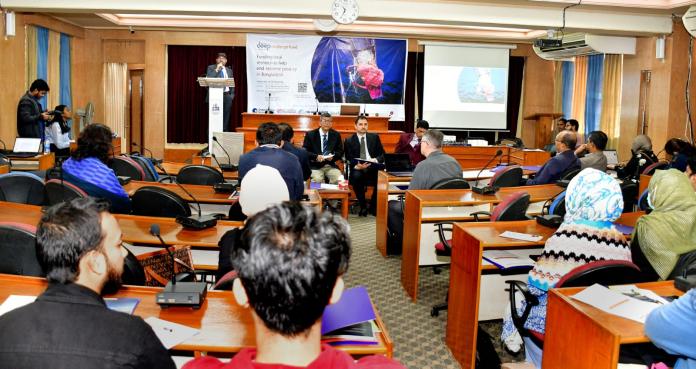
A bridge to the international research community. A further dimension of this support is the connection it creates between local researchers and the wider international research community. Through DEEP, awardees have access to cutting-edge data tools, such as small area estimation techniques developed within the DEEP consortium, as well as opportunities to collaborate with international researchers, present findings at international events, and engage with a global network of practitioners working on similar questions. This matters because research is not a local activity conducted in isolation – it is an international conversation, and ensuring that researchers in lower-income countries are full participants in that conversation, not just recipients of its conclusions, is part of what a well-designed research fund should be trying to achieve.
A research environment, not just a grant. Monthly progress reports are not box-ticking exercises – they are designed to flag risks early and keep teams on track. Working papers go through one or two rounds of independent quality assurance before publication, and are professionally copy-edited and formatted. All of this signals something about what we think the research is for: not just an internal milestone, but a contribution to a field.
Networks that outlast the programme. Perhaps the most important investment we make is in relationships – between awardees and steering committee members, between local researchers and the wider DEEP consortium, between research teams and the government officials who will eventually be asked to act on their findings. These networks do not disappear when the programme ends. They become the infrastructure through which future research happens, future funding is found, and future policy engagement becomes possible. A grants mechanism that creates nothing but papers has a limited legacy. One that builds a community of researchers with strong institutional connections has something that endures. We are now creating an open, curated group for our national steering committees, challenge fund applicants, and international researchers to have a space to engage with each other’s work and stay updated. More information on this will come out soon.
Reaching beyond the usual suspects
One of our ongoing preoccupations is the geography of research capacity. Every country we work in has a centre – usually one city, often one or two universities – where research is strong, where information about funding opportunities circulates easily, and where senior academics know how to write a winning proposal. And it has a peripherywhere those advantages are less reliable, less visible, and harder to access, making competing on equal terms genuinely difficult.
The underlying principle is simple: being embedded in an established research institution – with experienced colleagues, mentors, and easy access to information about opportunities – confers enormous advantages that a well-designed fund should actively work to counterbalance. We have made deliberate efforts to do this: visiting universities outside capital cities, targeting outreach at less established institutions, and actively encouraging applications from women researchers and underrepresented groups. The majority of competitive applications will always come from established researchers – that is the nature of any open competitive process. But we think it matters that the door is genuinely open to others – and that widening it is treated as a structural priority, not an afterthought. With each iteration of the fund, we have aimed to make this outreach more structured and more systematic.
The case for iteration
There is one further point we want to make, which is about time.
The benefits of this kind of model – mentorship cohorts, sustained networks, a critical mass of researchers who have been through the process and can support the next generation – compound over time. Running a challenge fund once is better than not running it at all. But the real value comes from doing it repeatedly: building cohorts, learning what works, improving the outreach and support structures with each iteration, and establishing a presence in a research community that is sustained rather than episodic.
This is a difficult argument to make to funders who are focused on what a single programme cycle can deliver. But we think it is an honest one. The infrastructure we are building through DEEP has value that will outlast the programme. The question is whether we – and the funders who make this work possible – are willing to invest in sustaining it.
What research that matters requires
The case for this model is not complicated. Research that is commissioned in response to what countries actually need, supported by an infrastructure that helps researchers do their best work and connect it to the people who can use it, and sustained over long enough to build real capacity – that research is more likely to matter.
It requires more of programme teams and funders than a conventional model does. It is slower, more relational, and harder to reduce to a log frame. But the alternative – research that is relevant to funders’ priorities rather than countries’ needs, that funds the same institutions repeatedly, and that offers nothing beyond the grant itself – has a well-documented track record of producing work that sits on shelves.
We think the ecosystem is worth building. Research programmes that invest in people and institutions – not just projects – are the ones most likely to leave something lasting behind: not just a body of evidence, but a research community with the capacity, the connections, and the credibility to keep generating it.
Read the companion piece: What does local ownership actually look like in a research programme?