
News and Insights
What does local ownership actually look like in a research programme?

-by Umar Salam and Jamie Williams | Originally posted by Oxford Policy Management.
Every research programme claims local ownership, but few can point to the specific decisions that make it real. Drawing on the DEEP Challenge Fund, this piece sets out what genuine local ownership looks like, and what it demands of funders.
Most development research programmes aim to create local ownership. It appears in logframes, in theories of change, in funding applications. But ask what it means in practice – what decisions it shapes, what it costs, what it requires you to give up – and the answers are often thin.
We have been running the DEEP Challenge Fund for the past two years, commissioning poverty research across Tanzania and Zanzibar, Ethiopia, Madagascar, and Bangladesh. We designed the Challenge Fund around a simple conviction: that local ownership means nothing unless it shapes the decisions that matter – what gets researched, who decides, and who is supported to do the work.
Here is what that has required in practice.
Start by asking, not assuming
The research agenda came from the countries, not from us. In each focus country, before any call for research was opened, we held in-country engagement workshops – bringing together government officials, academics, donors and civil society representatives to ask a simple question: what do you actually need to know?
The results were striking. Across four countries, we identified 23 thematic research priority areas. Fourteen of them were completely unique to an individual country. Not variations on a shared theme – entirely distinct priorities that would never have appeared on a research agenda set out in isolation by a funder.

This is not a minor methodological footnote. It is the foundation of everything else. Research agendas set at a distance – without the input of the governments, communities, and researchers who will be most affected – tend to reflect the priorities of funders, not countries. That gap is where relevance is lost. The 14-out-of-23 finding is, for us, the clearest evidence that local ownership has to begin at the very start – before the call is designed, before the criteria are written, before anything is decided.
Keep the experts in the room, throughout
After the engagement workshops, we established National Steering Committees in each country – 10 to 15 people drawn from the same cross-section of stakeholders who shaped the original priorities: government, academia, civil society, donors.
Crucially, these committees are not asked to rubber-stamp decisions made elsewhere. They are involved at every stage: helping to shape the research call, reviewing shortlisted applications, providing feedback to applicants at a final presentation workshop, and remaining engaged through implementation and into dissemination. When working papers come in, steering committee members are among the first reviewers.
The review process itself was designed with the same principles in mind. All applications that passed the initial sift were blind-scored by two to three independent reviewers – either national researchers or researchers with significant experience in the focus country – using a structured scoring matrix. This ensured that the quality bar was set by people with genuine understanding of local context, not by assessors far removed from the research environment they were evaluating.
This matters for two reasons. First, it means the research stays connected to what policymakers need as the work develops. Second, it means that by the time findings are ready to share, the people with the power to act on them have been part of the journey. They are not being presented with conclusions from the outside – they have watched the evidence build.
Local researchers lead; they do not “just deliver”
All research teams in the DEEP Challenge Fund are led by researchers from, or based in, the focus country. Making it a non-negotiable design requirement – rather than an aspiration – has been one of the most consequential decisions we made, and one we would advocate for in any research programme. The reasons are both analytical and strategic: understanding local context is not a background condition for good research – it is central to it. And research that is seen to come from outside is treated differently by the governments and policymakers who are being asked to act on it.
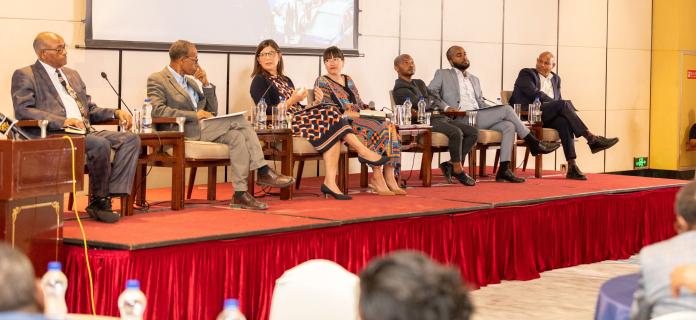
The Challenge Fund’s work in Zanzibar illustrates this clearly. The team at the Zanzibar Research Centre for Socioeconomic and Policy Analysis conducted research on creating a dynamic social registry to better identify and support poor households. When the findings reached government – eventually being presented to the Second Vice President of Zanzibar and heading toward an inter-ministerial committee and cabinet approval – the reception was notably positive. The experience in Zanzibar pointed to something important: research lands differently when it feels internally driven rather than externally imposed – built around what is needed, not around a preconceived agenda brought from outside.
That distinction – between research that is done to a country and research that is done by it – is, we think, the single most important factor in whether findings get used.
Invest in the ecosystem, not just the winners
One of the less visible commitments we have made is to unsuccessful applicants. After each round of the Challenge Fund, we sent personalised written feedback to every applicant who progressed past the initial sift. To date, that is around 500 individual letters.
This is not cost-free. It takes time and care. But it reflects a view of what a research programme is actually for. If you believe your job is only to fund the best projects in this cycle, feedback to unsuccessful applicants is waste. If you believe your job is to strengthen the research community over time – to build the field, not just fill grant slots – then it is an investment.
The same logic applies to our mentorship programme, which pairs early career researchers with senior members of the steering committee and with international researchers. Nearly half of our current awardees in Bangladesh and Madagascar have a formalised mentor. The aim is not only better outputs from this cohort – it is that these researchers carry something forward: stronger networks, greater exposure, a clearer sense of how to connect their work to policy audiences.
What this requires of funders
None of this is complicated in principle. But it does require funders and programme teams to accept a different role – one that is less controlling and more facilitative, slower at the front end, and more patient about when impact becomes visible.
It requires being willing to begin without having decided what the research agenda should be. It requires investing in relationships and institutions that will outlast the programme. It requires seeing rejected applicants as part of your constituency, not as people who simply did not make the cut.
And it requires accepting that the measure of success is not just about how many papers get published, but whether the governments and communities the research was meant to serve find it useful. Local ownership, in the end, is the condition that makes that possible.
This is the first blog in the series of blogs on the DEEP Challenge Fund model. Read the companion piece: Building the ecosystem, not just the evidence